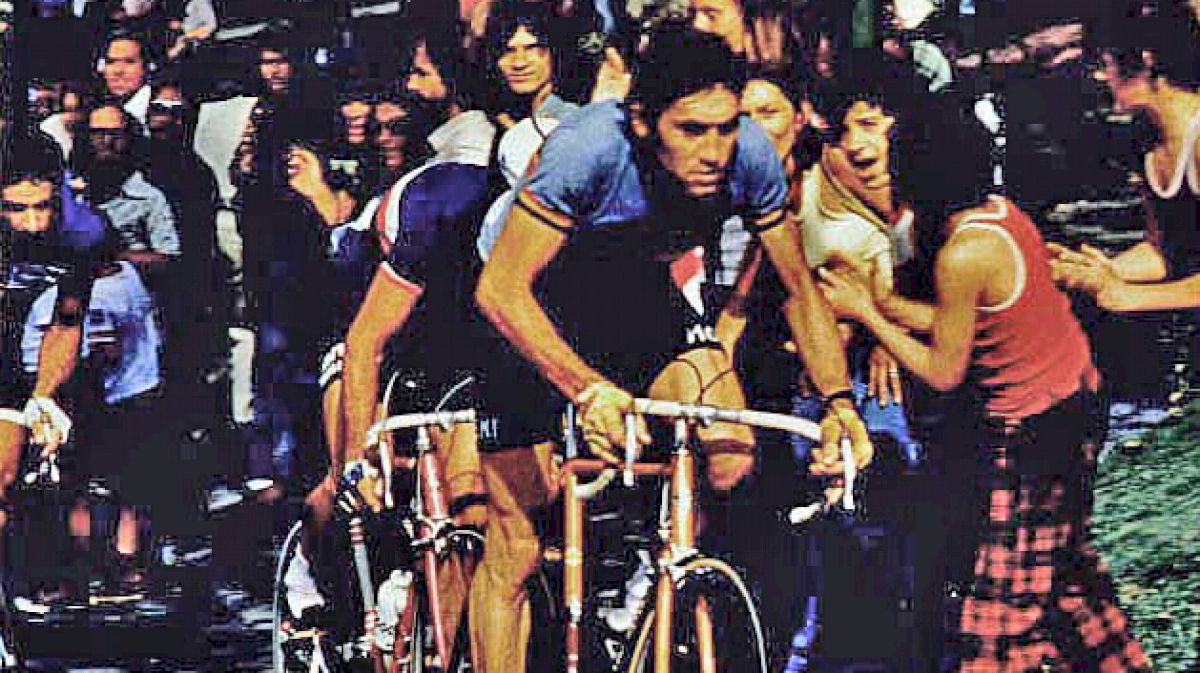
Fifty-two years before the rainbow jersey returns to Montréal, Eddy Merckx made cycling history on Mount Royal.
The 1974 UCI Road World Championships already represented a landmark moment before the Elite men's road race began. Montréal became the first city outside Europe to host the complete Road World Championships.
Then Merckx won.
- Subscribe To FloBikes To Watch The 2026 UCI Road World Championships
- Tadej Pogacar To Miss World Championships After Crash At Vuelta a España 2026
- USA Cycling Names Team USA Roster For 2026 UCI Road World Championships
He beat Raymond Poulidor and Mariano Martínez after a punishing 262.5-kilometer championship in which only 18 of 70 starters finished. The victory also completed Merckx's Giro d'Italia-Tour de France-World Championship Triple Crown, making him the first rider to win all three in the same season.
Now, 52 years later, Worlds is returning to Montréal — and Mount Royal once again will sit at the center of the championship.
Why The 1974 Montréal Worlds Made History
The historical significance of the 1974 World Championships begins with where they happened.
Montréal hosted the first complete UCI Road World Championships outside Europe.
There had been World Championship racing outside Europe before 1974. Montevideo hosted amateur events in 1968, but the professional and women's world titles remained in Europe.
Montréal was different.
In 1974, the complete championship crossed the Atlantic, bringing the professional men's and women's titles to Canada.
That made Montréal an important milestone in the geographical expansion of one of cycling's biggest championships.
And the city provided a demanding setting for it.
Inside The 1974 Men's World Championship Road Race
Mount Royal was at the center of the Elite men's championship.
The 1974 race consisted of 21 laps of an approximately 12.5-kilometer Mount Royal circuit, producing a total distance of 262.5 kilometers.
Seventy riders started.
Only 18 finished.
Those numbers alone give modern cycling fans a sense of the severity of the championship without needing to embellish the race with details that aren't established in the research.
The event also attracted an enormous audience. Approximately 200,000 spectators were estimated to have attended the Elite weekend.
The stage was set for one of cycling's biggest names to complete an extraordinary season.
Eddy Merckx Wins The Rainbow Jersey In Montréal
Merckx won the Elite men's road world championship, with Poulidor taking second and Martínez finishing third.
That victory gave Merckx the rainbow jersey, but its significance extended far beyond the World Championship itself.
Merckx had already won the Giro d'Italia and Tour de France in 1974.
Winning on Mount Royal completed something that had never been accomplished before.
Eddy Merckx Completes Cycling's Triple Crown
With his victory in Montréal, Merckx became the first rider to win the Giro d'Italia, Tour de France and World Championship road race in the same season.
That combination became known as cycling's Triple Crown.
The accomplishment remains rare enough that only two riders identified in the research later matched it.
Stephen Roche did so in 1987.
Tadej Pogačar matched it in 2024.
That puts Merckx's Montréal victory into its proper historical context.
He wasn't merely adding another world title. His victory completed a three-race combination that would stand unmatched for 13 years and has been equaled only twice in the decades since.
And the final piece came on Mount Royal.
That gives Montréal a permanent place in the history of one of cycling's most celebrated achievements.
Geneviève Gambillon Won The Women's World Title
Merckx was not the only world champion crowned in Montréal.
France's Geneviève Gambillon won the women's championship, with Baiba Caune finishing second and Keetie van Oosten-Hage third.
Gambillon already had been world champion in 1972, making Montréal her second title.
Her victory is an important part of what made the 1974 event historically significant.
This wasn't simply the first professional men's world championship held outside Europe. Montréal hosted the complete Road World Championships, including the women's world-title race.
Fifty-two years later, both Elite rainbow jerseys will again be decided in the same Canadian city.
1974 Vs. 2026: Same Mountain, Different Course
There is an obvious temptation to describe the 2026 World Championships as a return to the same course Merckx conquered.
That isn't accurate.
The cleaner comparison is: same mountain, same host city, different championship architecture.
In 1974, the Elite men raced 21 laps of an approximately 12.5-kilometer Mount Royal circuit for 262.5 kilometers.
The 2026 men's race is 273.7 kilometers with 3,803 meters of climbing and has a fundamentally different structure.
Instead of beginning with lap after lap around Mount Royal, the race starts at Quartier DIX30 in Brossard. It travels through the Montérégie before crossing toward Montréal.
Only then does the championship settle into its defining circuit.
The Elite men will complete 12 laps of a 13.4-kilometer Mount Royal finishing circuit largely derived from roads familiar from the modern Grand Prix Cycliste de Montréal.
The routes therefore should not be described as identical.
Mount Royal is the connection.
Mount Royal Will Again Decide A World Champion
The 2026 circuit includes repeated trips over Voie Camillien-Houde, approximately 2.3 kilometers averaging 6.2%, and Chemin de la Polytechnique, where ramps exceed 11%.
After 12 finishing laps and nearly 274 kilometers, the men's race ends on the rising Avenue du Parc.
The details are modern.
The setting carries history.
In 1974, repeated racing around Mount Royal reduced a 70-rider men's field to just 18 finishers before Merckx emerged as world champion.
In 2026, the mountain again will become the centerpiece of the race for the rainbow jersey, even though the route around it has changed dramatically.
Why Montréal's Worlds History Matters In 2026
When the UCI Road World Championships return to Montréal, they aren't arriving in a city without a championship past.
They are returning to the place where the complete Road World Championships first left Europe.
They are returning to the city where Gambillon won her second women's world title.
And they are returning to Mount Royal, where Merckx completed the first Giro-Tour-Worlds Triple Crown in cycling history.
Much has changed in 52 years.
The course has changed. The structure of the championship has changed. The riders trying to win the rainbow jersey have changed.
Mount Royal remains.
In 1974, it provided the setting for one of the defining achievements of Merckx's career.
In 2026, Montréal gets to make World Championship history again.
Catch All The Best Races, Highlights, Insight, News And More On FloBikes
FloBikes is the streaming home to some of the best cycling from across the globe. Check out the broadcast schedule to watch more of your favorites in action.
FloBikes Archived Footage
Video footage from each event will be archived and stored in a video library for FloBikes subscribers to watch for the duration of their subscriptions.