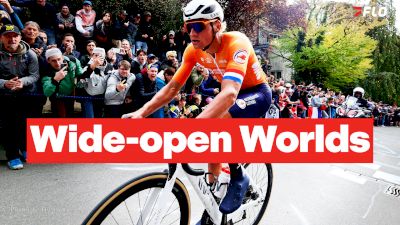
If you're accustomed to watching the Tour de France or other major professional cycling races, the UCI Road World Championships can look a little strange.
The familiar professional teams disappear.
Instead of UAE Team Emirates-XRG, Visma-Lease a Bike, Lidl-Trek or Red Bull-BORA-hansgrohe, riders line up representing their countries. That means cyclists who spend most of the season working together can suddenly become opponents — while riders who normally race against each other can become teammates.
- Subscribe To FloBikes To Watch The 2026 UCI Road World Championships
- Tadej Pogacar To Miss World Championships After Crash At Vuelta a España 2026
- USA Cycling Names Team USA Roster For 2026 UCI Road World Championships
That's because the UCI Road World Championships are contested by national teams rather than professional trade teams. National cycling federations select riders within their country's allocations, and those riders race for their nation with one goal: winning a world championship.
It is one of the biggest differences between Worlds and the races fans watch throughout the professional season.
Why Do Cyclists Race For Countries At The UCI Road Worlds?
For most of the professional road season, cyclists compete for what are commonly called trade teams — their regular professional employers.
Worlds works differently.
National federations select the riders who represent their countries within their UCI allocations. The size of each national squad can vary.
The 2026 Elite men's selections illustrate that difference. Belgium and the United States each have eight road riders, while host Canada has six.
Once Worlds begins, a rider's professional team does not determine his race-day allegiance.
The jersey on his back does.
What Happens To Pro Cycling Teams At Worlds?
Professional teams don't determine the alliances in the World Championship road race.
That creates situations casual cycling fans rarely see during the rest of the season.
Isaac del Toro and Brandon McNulty both race professionally for UAE Team Emirates-XRG in 2026. At Worlds, Del Toro represents Mexico and McNulty represents the United States.
Remco Evenepoel and Primož Roglič are trade teammates at Red Bull-BORA-hansgrohe. In Montréal, Evenepoel represents Belgium, while Roglič represents Slovenia.
Lidl-Trek riders similarly can be distributed among several different countries.
That means a rider who normally spends the season helping a teammate win could find himself trying to beat that same rider for the rainbow jersey.
Normal Teammates Can Become Rivals At Worlds
Del Toro and McNulty provide a particularly useful example entering the 2026 World Championships.
At the Grand Prix Cycliste de Montréal on Sept. 13, Del Toro won and McNulty finished third. During the regular professional season, they share a trade team.
At Worlds, they don't.
If Del Toro attacks for Mexico during the Elite men's road race, McNulty's responsibility is to the United States. Their normal UAE Team Emirates-XRG relationship is irrelevant to their race-day allegiance.
The same principle applies to Evenepoel and Roglič.
Instead of racing as Red Bull-BORA-hansgrohe teammates, they enter Worlds representing different nations with potentially competing interests.
Understanding that distinction makes the World Championships much easier to follow.
Normal Rivals Can Become Teammates
Worlds also reverses the equation.
Riders who compete for different professional teams throughout the season can suddenly find themselves wearing the same national jersey.
Belgium offers one of the clearest examples in Montréal.
Its confirmed Elite men's road team includes Remco Evenepoel, Wout van Aert, Tiesj Benoot, Thibau Nys, Quinten Hermans, Alec Segaert, Maxim Van Gils and Gianni Vermeersch.
Those riders do not all share a professional team during the regular season.
At Worlds, they're all Belgium.
That creates combinations that simply do not exist during most of the cycling calendar. Evenepoel provides Belgium with elite solo power, while Van Aert offers a different potential route if a reduced group remains together.
The research also identifies riders such as Nys, Van Gils, Benoot and Hermans as additional Belgian tactical options.
Exactly how Belgium uses them cannot be known in advance. The important point for newer fans is that Worlds creates an entirely new team structure.
Who Selects Riders For The UCI Road World Championships?
The national cycling federations determine their World Championship selections within their UCI allocations.
Those allocations mean countries do not necessarily arrive with the same number of riders.
For Montréal, the United States has an eight-man Elite road roster featuring Matteo Jorgenson, Brandon McNulty, Neilson Powless, Sean Quinn, Artem Shmidt, Quinn Simmons, Kevin Vermaerke and Larry Warbasse.
Canada's Elite men's road team has six riders: Derek Gee-West, Hugo Houle, Michael Leonard, Michael Woods, Nickolas Zukowsky and Pier-André Côté.
The difference matters because national-team depth can influence how many options a country has during a difficult championship.
How Do National Teams Change Worlds Tactics?
The national-team format helps make World Championship racing less predictable than normal trade-team racing.
A country can arrive with one clear leader, multiple leaders or several riders capable of becoming opportunistic options depending on how the race develops.
Belgium has Evenepoel and Van Aert.
Great Britain has Tom Pidcock along with Adam Yates and Oscar Onley.
France has 19-year-old leader Paul Seixas supported by additional climbing depth, including Pavel Sivakov and Valentin Paret-Peintre.
The United States does not necessarily have the single strongest favorite, but its depth makes it particularly interesting. McNulty finished third at GP Montréal and Simmons fourth, while Jorgenson, Powless, Quinn and others give the Americans additional riders capable of becoming involved in moves.
Del Toro presents a different situation. He just won GP Montréal and has demonstrated that the Mount Royal terrain suits him, but the research identifies less national-team depth compared with a country such as Belgium as one potential vulnerability.
None of that dictates how those countries will race.
It explains why their options are different.
What National Teams Mean For The 2026 UCI Road Worlds
The team dynamic could become particularly important in Montréal because of the difficulty of the Elite men's road race.
The championship covers 273.7 kilometers with 3,803 meters of climbing. After the approach from Brossard and the Montérégie, the men complete 12 laps of the 13.4-kilometer Mount Royal finishing circuit.
Repeated climbing means simply having teammates survive deep into the race could become valuable.
And when the decisive moments arrive, cycling fans need to forget many of the relationships they've watched throughout the professional season.
Evenepoel isn't racing for Red Bull-BORA-hansgrohe. Del Toro isn't racing for UAE Team Emirates-XRG. Pidcock isn't racing for Q36.5.
They're racing for Belgium, Mexico and Great Britain.
For one World Championship race, the professional teams disappear, normal teammates can become rivals and normal rivals can become teammates.
And that's part of what makes racing for the rainbow jersey so different.
Catch All The Best Races, Highlights, Insight, News And More On FloBikes
FloBikes is the streaming home to some of the best cycling from across the globe. Check out the broadcast schedule to watch more of your favorites in action.
FloBikes Archived Footage
Video footage from each event will be archived and stored in a video library for FloBikes subscribers to watch for the duration of their subscriptions.