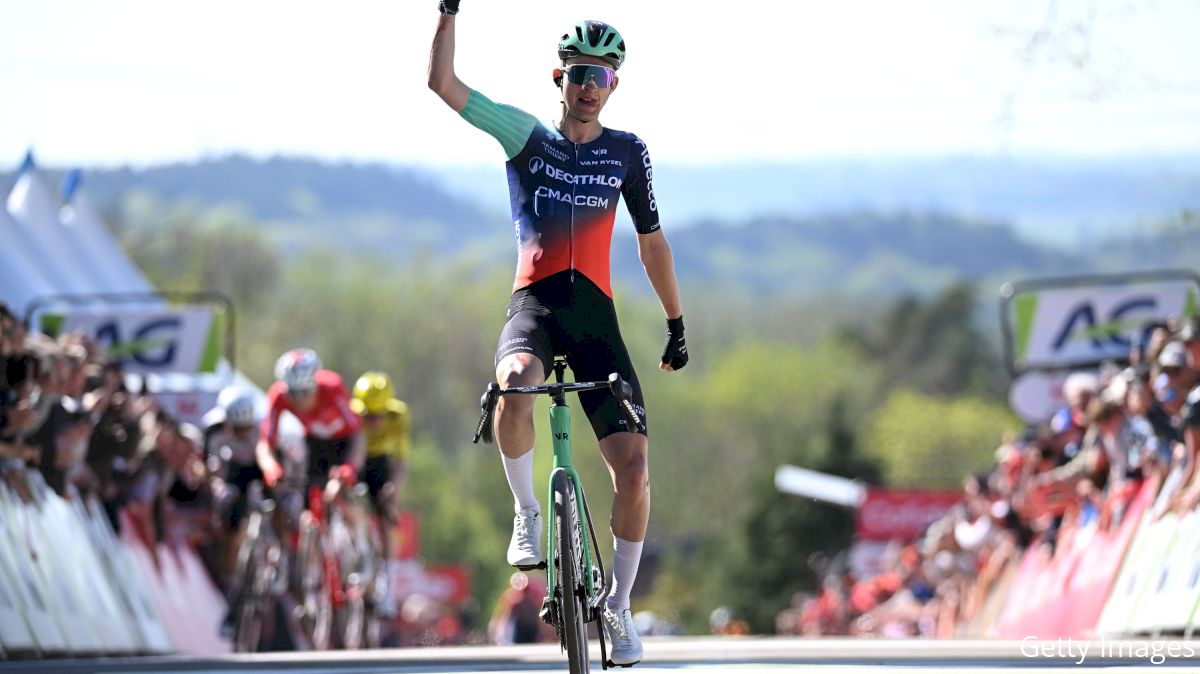
Paul Seixas is 19 years old, and France is bringing him to Montréal with something much bigger than experience in mind.
Seixas has been confirmed as a French leader for the Elite men's road race at the 2026 UCI Road World Championships. He arrives after finishing second to Isaac del Toro at the Grand Prix Cycliste de Montréal, winning La Flèche Wallonne and finishing fourth at the Tour de France in 2026.
- Subscribe To FloBikes To Watch The 2026 UCI Road World Championships
- Tadej Pogacar To Miss World Championships After Crash At Vuelta a España 2026
- USA Cycling Names Team USA Roster For 2026 UCI Road World Championships
He also turns 20 during World Championships week.
That combination makes Seixas one of the most unusual stories entering the men's road race Sept. 27. He may be one of the youngest major contenders in Montréal, but his results mean he no longer can be discussed simply as a star for the future.
Who Is Paul Seixas?
Seixas is a 19-year-old French rider who races for Decathlon CMA CGM during the 2026 trade-team season.
His age immediately stands out, but his results explain why France is willing to place so much responsibility on him.
Seixas won La Flèche Wallonne in 2026 and finished fourth at the Tour de France. Then, one week before the World Championships begin, he delivered perhaps the most relevant performance of all.
He finished second at GP Montréal.
Del Toro won the race, while Brandon McNulty finished third, Quinn Simmons fourth, Remco Evenepoel fifth and Tom Pidcock sixth.
Against a group filled with riders who will matter at Worlds, Seixas was beaten only by Del Toro.
Paul Seixas' 2026 Season Changed Expectations
A fourth-place finish at the Tour de France and a Flèche Wallonne victory already would make Seixas one of the most notable young riders entering the World Championships.
His GP Montréal performance made his case even stronger.
The research identifies climbing and punch as two of Seixas' greatest strengths, characteristics that appear particularly valuable for the World Championship course.
Montréal isn't built around one enormous climb. Instead, the Elite men face 273.7 kilometers and 3,803 meters of climbing, with the final portion of the race centered on repeated trips around Mount Royal.
That combination places a premium on riders who can climb, accelerate and continue producing those efforts deep into a difficult one-day race.
Seixas' 2026 results suggest he belongs in that conversation.
His age remains the extraordinary part.
France isn't merely bringing a talented teenager to gain experience. Seixas arrives with a leadership role and legitimate evidence that he can compete against the riders expected to challenge for the rainbow jersey.
What GP Montréal Told Us About Paul Seixas
GP Montréal offered the most direct preview yet of what Seixas might be capable of at Worlds.
Del Toro and Seixas separated late on the Mount Royal circuit, with McNulty leading the pursuit behind them. Seixas stayed with the eventual winner into the decisive finale before finishing second.
That matters because most of the World Championships' 13.4-kilometer finishing circuit uses roads familiar from GP Montréal.
Seixas therefore didn't produce his biggest pre-Worlds result on unrelated terrain. He did it on roads that will be central to the championship itself.
And he finished ahead of McNulty, Simmons, Evenepoel and Pidcock.
It is still important not to treat GP Montréal as a miniature version of Worlds.
The World Championship adds a long approach from Brossard and the Montérégie before the Elite men complete 12 Mount Royal laps. At 273.7 kilometers, it creates an endurance test beyond what GP Montréal alone can answer.
Seixas proved he can contend on the terrain.
Worlds will ask whether he can do it after nearly 274 kilometers.
Why The Montréal Worlds Course Could Fit Seixas
The Mount Royal circuit seems well matched to the qualities that have made Seixas such an intriguing contender.
The men complete 12 laps of the 13.4-kilometer circuit, with roughly 269 meters of climbing per lap.
Voie Camillien-Houde is approximately 2.3 kilometers averaging 6.2%. Chemin de la Polytechnique adds ramps exceeding 11%. The course eventually returns toward an uphill false-flat finish on Avenue du Parc.
The challenge comes from repeating those efforts.
The research characterizes Seixas as possessing exceptional climbing and punch, exactly the combination that could become increasingly valuable as the field accumulates thousands of meters of climbing.
But there is another side to that equation.
A 273.7-kilometer Elite World Championship creates an enormous endurance test, and Seixas will carry extraordinary responsibility for a rider who still is 19 entering championship week.
Those questions cannot be answered by his GP Montréal result alone.
France Is Putting Its Faith In A Teenager
Seixas won't enter the World Championship without French depth around him.
France's team includes climbing options such as Pavel Sivakov and Valentin Paret-Peintre, giving the country more than just its teenage leader for a race expected to become increasingly selective on Mount Royal.
The research describes France as unusually young but possessing climbing depth behind Seixas.
Exactly how France deploys those riders cannot be assumed in advance. World Championships racing also differs from normal trade-team competition because riders compete for their countries, creating tactical combinations that do not exist during most of the season.
What is clear is where Seixas stands.
France has confirmed him as a leader.
At 19.
Can Paul Seixas Win The Rainbow Jersey?
That's the question Montréal will answer.
There are plenty of reasons not to treat second place at GP Montréal as a prediction.
Worlds is longer. The cumulative climbing is substantial. National-team tactics will change the race. And Seixas will face contenders including Del Toro, Evenepoel, Pidcock, Mathieu van der Poel, Wout van Aert and others in a championship made even more open by Tadej Pogačar's absence.
But Seixas already has answered the question of whether he deserves to be taken seriously.
He won La Flèche Wallonne. He finished fourth at the Tour de France. He finished second at GP Montréal after staying with Del Toro into the decisive finale. Now France has put him in a leadership position for Worlds.
Seixas enters Montréal at 19 years old and will turn 20 during championship week.
He may be one of cycling's most exciting riders for the future.
The remarkable part is that he already has a chance to win now.
Catch All The Best Races, Highlights, Insight, News And More On FloBikes
FloBikes is the streaming home to some of the best cycling from across the globe. Check out the broadcast schedule to watch more of your favorites in action.
FloBikes Archived Footage
Video footage from each event will be archived and stored in a video library for FloBikes subscribers to watch for the duration of their subscriptions.