With its perfectly balanced cocktail of hills, flats, and technical turns, the UCI Road World Championships course in Bergen, Norway, seemed designed to keep riders guessing in Saturday’s competition. It did the same for spectators, too, giving them the best of the professional peloton—and not just in terms of exciting, aggressive tactics, or the caliber of cyclists.
Only in the final stretch was it clear that the Netherland’s Chantal Blaak had the gold. Blaak’s Dutch teammates Annemiek van Vleuten and Anna van der Breggen were sitting on the race’s final breakaway, ready to move if the chasing competitors started to close down their teammate. Hannah Barnes of Great Britain, Katarzyna Niewiadoma of Poland, and Audrey Cordon of France pursued from behind.
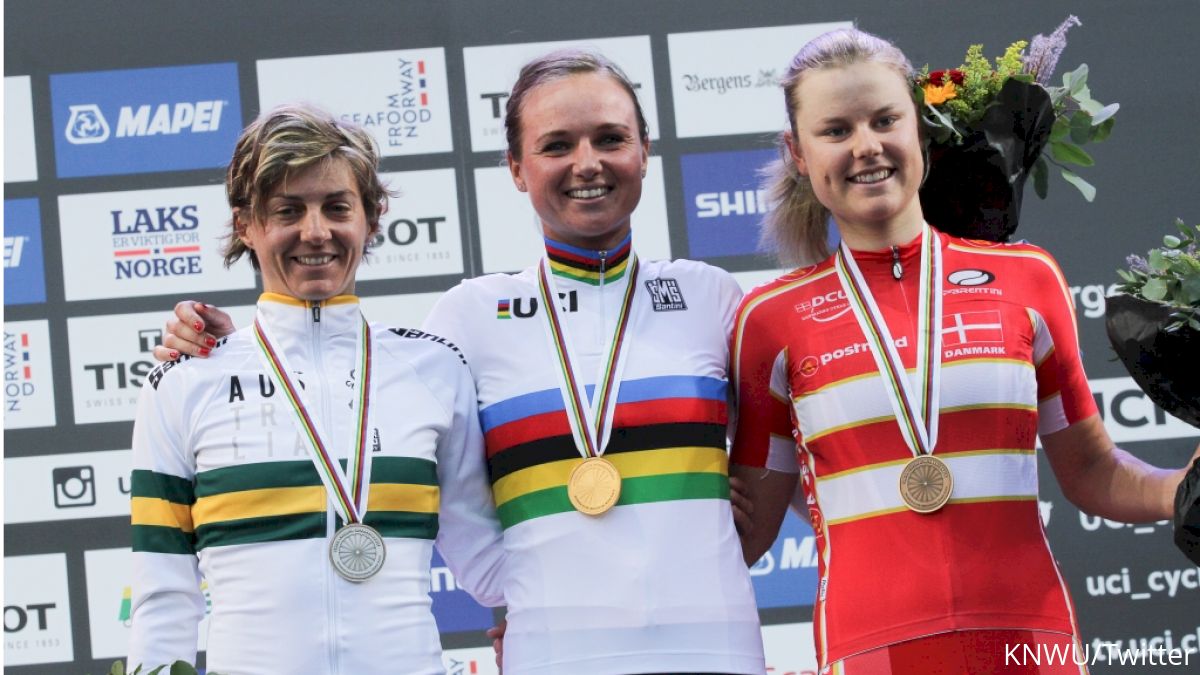
But the chase failed to mobilize, and Blaak, who’d attacked hard following the descent of Salmon Hill, crossed the line alone with 28 seconds to spare.
From the break, Australia’s Katrin Garfoot took silver, jumping just before the peloton caught at the line, and in the field sprint behind her Amalie Dideriksen of Denmark won the battle for bronze.
The elite women’s UCI World Championships on September 23 gave us the best of the professional peloton—and not just in terms of an exciting, aggressive race or the caliber of rider. It taught us lessons that speak to the very heart and soul of what it means to be a bike racer.
1. Be A Team
No one doubted the Dutch were the team to watch at worlds, but there was plenty of speculation about whether there might be too many chiefs. Each of the eight Dutch riders was so talented in her own right that disagreement about who would work for whom seemed like a potential Achilles heel.
However, on race day, there were orange jerseys in nearly every move—in most cases aggressively initiating them—and in numbers that made going up against them formidable, if not impossible. The team showed no difficulties in working together smoothly and intuitively; no rider seemed afraid to play her part.
2. Carry On
After the junior women individual time trial world championships on September 18, photos circulated on social media of Great Britain’s Lauren Dolan with deep lacerations in her legs after a crash on the course; in a feat of chutzpah, Dolan had finished the race on a spare bike.
In the elite women’s road championships, when Blaak attacked with 23km to go and was joined by Cordon and Barnes, race commentators noted the road rash on her right shoulder and the back of her leg. Blaak had gone down hard in a crash near the front of the race around 66 kilometers.
Comparatively, Blaak’s injuries were minor—U.S. rider Megan Guarnier suffered a broken jaw—but the crash could still have meant the end of the race, if only psychologically, for a lesser rider; getting back on her bike was Blaak’s first step to gold.
“Actually, I was in a lot of pain at that moment and I thought my race was over,” she said. “Then I thought, ‘Maybe I can come back and see what I can do.’”
3. Show Them What You’re Made Of
Controversy surrounded the Australian selection process for the road race when new performance director Simon Jones opted to select only five riders for worlds instead of filling the seven positions allowed. The PR was bad, the mood was sour, and two riders appealed and won spots on the team. Whether the pre-race drama put more fire in Australian legs on race day or took away from it, the team got their moment in the sun when Garfoot crossed the line in second place.
Although the 35-year-old Australian, who also took bronze in the TT world championships last week, said she didn’t wish to take sides on the issues surrounding team selection, she seemed to imply nonetheless that the performance had proven a point.
“I'm not sure how it will all unfold in the future,” she said. “Maybe this medal is a good thing and now we’ll be taken more seriously. I think that women’s cycling is being taken more seriously. Let’s just hope that's a good step up for Australia cycling. I think that’s happening in the world and so will perhaps Australian cycling will follow suit."
By Kathryn Hunter