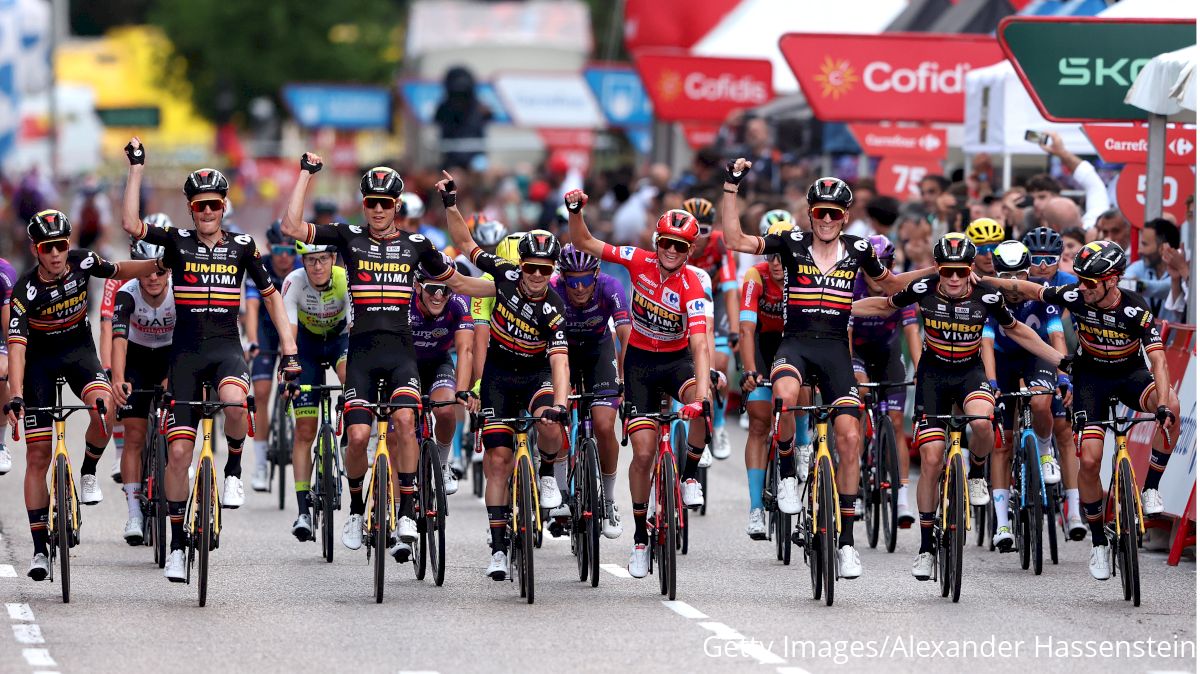
During the Vuelta a España 2025, the final Grand Tour of the year, riders from 23 teams will endure 21 challenging stages over all kinds of terrain.
The journey will span more than 3,100 kilometers and take them into four countries – Italy, France, Andorra and Spain – from Aug. 23 to Sept. 14.
The race’s 90th edition will begin in northern Italy’s Turin and conclude in Madrid.
- Subscribe To FloBikes To Catch All The Best Cycling, News And Highlights
- Don’t Miss Any Of The Action On FloBikes – Get An Annual Subscription!
- When Is The Vuelta A España 2025? Here's What To Know
- The 2025 Cycling Streaming Schedule On FloBikes: What To Know
This year, La Vuelta will feature seven medium mountain stages, six mountain stages, five flat stages, two time trials and a hilly stage with a high-altitude finale, all broken up by two well-earned rest days.
Really, it’s a year for the climbers and most versatile riders. They’ll be surrounded by history and tradition and forced to face some of Europe’s steepest climbs.
Vuelta a España 2025 Stage-By-Stage Analysis
Here’s a look at all 21 stages of the Vuelta a España 2025.
To see the detailed maps of the route and stages, visit the race's official site.
Stage 1 – Aug. 23: Torino - Reggia di Venaria to Novara (186.1km)
Though there’s a Category 3 climb in the opening stage, the route is relatively flat.
The climb will determine who gets to wear the first King of the Mountains jersey, but the stage is expected to end in a sprint finish, meaning it should be one of the fast men who’s the first to wear the coveted red leader’s jersey at the Vuelta a España 2025.
History shows that it has been nearly two decades since a sprinter took Stage 1 of the race.
Stage 2 – Aug. 24: Alba to Limone Piedmonte (159.6km)
Stage 2 also is on the flatter side, but there is a little bit of incline to challenge the riders and get them warmed up for what’s ahead. They’ll see a 5% gradient for about 10 kilometers.
Oh, and it’s the first summit finish of this year’s event.
Who wins this stage could be a toss-up, however. Because it’s shorter and flatter and not super tough on the legs, it easily could end in another sprint. But if someone wants to take a risk and break free, well, that takes the sprint out of play.
Stage 3 – Aug. 25: San Maurizio Canavese to Ceres (134.6km)
Three days, three kinds of terrain. And the final full day in Italy.
Stage 3 qualifies as the first of the medium mountain stages, but it also is the second-shortest of the non-time-trial stages this year.
There’s a Category 2 climb in the middle and a continuous climb in the final kilometers, meaning the sprinters should have the day off, so to speak. Instead, the riders with more tools in their toolboxes will have a chance to show off their versatility and potentially pick up some time.
Stage 4 – Aug. 26: Susa to Voiron (206.7km)
Here’s another medium mountain stage, this time with three categorized climbs – Cat 3, Cat 2, Cat 2 – all of which happens in the first half of the year’s longest stage.
This one leads from Italy into France, which the cycling world is very familiar with after the recent Tour de France.
The second half of the day is much flatter, so once teams get over the climbs, they can strategize, speed up and get organized to likely set up another sprint for the finish line.
Stage 5 – Aug. 27: Figueres (team time trial) (24.1km)
This is the first of two time trials, but it’s a team competition. It’s a short 24.1 kilometers, but a challenging ride nonetheless. That means strategy, teamwork and everyone understanding and executing their roles.
Even novice cycling fans would know to keep the closest eye on Team Visma | Lease a Bike and UAE Team Emirates as the most well-round teams in the race.
For the first, Sepp Kuss won La Vuelta in 2023, while Jonas Vingegaard is the favorite to win this year.
On the latter, the team of two-time reigning Tour de France winner Tadej Pogacar, it’ll be an opportunity for other riders to shine in his absence. Keep an eye on João Almeida and Juan Ayuso.
Stage 6 – Aug. 28: Olot to Pal.Andorra (170.3km)
This is the first of three consecutive mountain stages and features four categorized climbs – two in the first half and two in the second half – with the last one into Pal officially bringing the race into Andorra with a summit finish.
The stronger climbers will have the chance to shine in Stage 6, fighting for the King of the Mountains jersey, the stage win and potentially the red leader’s jersey, too.
Stage 7 – Aug. 29: Andorra La Vella to Cerler (188km)
We’re back in the mountains and set for another four challenging climbs, the first of which is the long and relentless Port del Canto, less than 40 kilometers into the 188-kilometer day.
The other climb of note is the final ascent to Cerler, a tough climb that made regular appearances earlier in the 90-year history of La Vuelta.
The GC may not be won on these back-to-back mountain stages, but it certainly could be lost.
Stage 8 – Aug. 30: Monzón Templario – Zaragoza (163.5km)
La Vuelta 2025 is back in Spain, and while Stage 8 is classified as a mountain stage on the race’s official route, it’s relatively flat and set up perfectly for the sprinters to have another chance at the podium.
The day should offer a rest for tired climbers, while the biggest challenge should be the unpredictable winds and weather.
Oh, and there’s a lot of history in Zaragoza, which is hosting its 50th Vuelta a España stage.
Stage 9 – Aug. 31: Alfaro – Valdezcaray (195.5km)
The riders will be rolling into the first rest day of this year’s Vuelta, as Stage 9 is a hilly one, with a challenging summit finish to the Valdezcaray ski station, a climb of about 13 kilometers at an average gradient of 5%.
It’s not the toughest day the competitors will face, but they’ll likely be feeling the effects of the intense first week of racing.
This stage also may provide a chance for an ambitious rider or two to attempt to break away and end the first part of the race with some fireworks, or push one of the versatile GC hopefuls to make a statement and give his rivals something to think about during the rest day.
Stage 10 – Sept. 2: Sendaviva – Larra-Belagua (175.3km)
If this stage looks familiar, it’s because it was featured in the 2023 edition of La Vuelta.
The riders will be rested and ready for a day that starts out flat and gradually increases in elevation, leading into a Category 3 climb at about 125 kilometers in and concludes with a Category 1 climb to El Ferial Larra Belagua at the border to France.
Stage 11 – Sept. 3: Bilbao (157.4km)
Stage 11 brings the riders to Spain’s Basque Country, specifically Bilbao, which hosted the Grand Depart of the Tour de France in 2023.
This time, the competitors will endure 157.4 kilometers, entirely in Bilbao, where they face seven categorized climbs that only can be described as short and punchy. One of the noteworthy ones is the last one, a tough climb to Pike Bidea, just shy of the finish line.
For those less familiar with cycling terminology, there’s actually a type of rider who specializes in short, steep climbs called a puncheur or puncher, so this stage will offer them a moment in the spotlight, too.
Stage 12 – Sept. 4: Laredo – Los Corrales del Buelna (144.9km)
Some of the riders in this year’s Vuelta weren’t yet born the last time a stage of the race finished in Los Corrales de Buelna, while others may have been on their tricycles growing their passion for cycling.
That’s all silly, but true, as it last happened in 1999.
This time, it will come at the end of a 144.9-kilometer journey that includes two categorized climbs (Cat 2 and Cat 1) that will test the riders before they reach a flat finish that should be fast and furious.
The question is, will the climbs lead to a breakaway win, or will this stage be settled in a sprint?
Stage 13 – Sept. 5: Cabázon de la Sal – L’Angliru (202.7km)
This is the second-longest stage of this year’s Vuelta, and it will begin with a ride along the coast.
The terrain will become increasingly more challenging, and the final 50 kilometers will feature two Category 1 climbs, along with the iconic climb to Angliru to finish the day.
Angliru is a known battleground for the GC contenders, and it’s one of the steepest and most challenging climbs in cycling. The trek is 13 grueling kilometers with an average gradient of 9% that reaches as high as 20% toward the end.
If this stage had a theme song, it might be “Legends Are Made” by Sam Tinnesz.
Stage 14 – Sept. 6: Avilés – La Farrapona (135.9km)
We go from one of the longest stages to one of the shortest, but that doesn’t mean it’s easy.
The back half of this 135.9-kilometer journey includes a Category 3 climb and two Category 1 climbs, with the finale being a summit finish at La Farrapona, which is a newer feature in the long history of La Vuelta, but has become a favorite for fans and riders.
While it’s a challenging climb, the scenery is known to be breathtaking, and the terrain is the perfect setup for potential attacks and exciting racing.
Stage 15 – Sept. 7: A Veiga – Monforte Lemos (167.8km)
Just like that, we’re on the verge of another rest day.
There’s no scenic lead in here - the climbing starts almost immediately, as the two categorized climbs show up in the first half of this stage. The rest of the 167.8 kilometers is rolling hills.
This stage certainly has the potential for a rider, or group of riders, to break away, but everyone should be prepared for aggressive moves throughout. Bravery and strategy could win this one.
Stage 16 – Sept. 9: Poio – Mos Castro de Herville (167.9km)
We’re back from the second rest day of this year’s race, but there won’t be anything restful about Stage 16.
This is the sixth of seven consecutive stages that are considered mountain or medium mountain stages, and the second half of the day will include four categorized climbs. The final one, a climb of Castro de Herville, was part of La Vuelta in 2021, so some riders already have taken on this test.
Throughout the day, the riders will experience winding roads, tough mountain passes and rugged terrain.
Stage 17 – Sept. 10: O Barco de Valdeorras – El Morredero (143.2km)
Stage 17 will be another nostalgic day at La Vuelta 2025, as the race returns to the El Morredero for the first time since 2006. It’s the second-to-last summit finish of this year’s race.
The 23-kilometer final climb reaches 12% gradient, while the average is about 5%.
The next two days will be an individual time trial and a flat stage, so Stage 17 is a good time for the climbing specialists to empty the tank.
Stage 18 – Sept. 11: Vallodolid (individual time trial) (27.2km)
Stage 18 is an individual time trial that features relatively basic terrain and wide roads.
Again, there are riders who specialize in time trials, so this will be their chance to shine and even gain time, as being good at other things really won’t factor in here.
Because this stage is on the longer side for an ITT, the impact could be greater for those who excel in this format. GC contenders who aren’t the best at time trials will just need to minimize any damage.
Stage 19 – Sept. 12: Rueda – Guijuelo (161.9km)
Two of the last three stages of this year’s Vuelta a España are flat, and this is one of them.
A sprint finish is forecasted, but there are two things that could change that – the effects of the winds on this flatter terrain and the possibility of an escape that could ruin the day for the sprinters.
Stage 20 – Sept. 13: Robledo de Chavela – Bola del Mundo (165.6km)
One final mountain stage could decide the winner of this year’s Vuelta, and this one has it all, including climbs from the beginning to the end. This is one of the most frequently used mountain areas for La Vuelta.
The final challenge is called the Bola del Mundo, and it is one of the toughest climbs of all 21 stages of La Vuelta. Gradients will hit the double digits in its final kilometers, and a win on this day will be well-earned.
For any climbers looking to make a dent in the GC standings before the race concludes, this is the time to do it. Obviously, since there’s only one stage left, and it’s a flat one for the sprinters.
Stage 21 – Sept. 14: Alalpardo – Madrid (111.6km)
This is it. The grand finale. The end of the road. More than 3,100 kilometers have been covered.
Last year, La Vuelta ended with an individual time trial, so it was a little anticlimactic for winner Primoz Roglic, his team and all the others who had a successful race and just wanted to celebrate.
This time, however, the traditional final stage is back in place, and it will be a day filled with celebration, photos, reflection, camaraderie – and THEN a final chance for the sprinters to claim a stage of this year’s race.
All of the fun will happen within the city limits of Madrid. The day will begin in Alalpardo, but the final 50 kilometers or so will be a circuit around the capital city.
The last sprint finish to conclude La Vuelta, in 2023, featured Australia’s Kaden Groves edging Filippo Ganna and Nico Denz at the line. It was the third stage win of the year for Groves.
How To Watch The Vuelta A España 2025
For Canadian viewers, the Vuelta A España 2025 will be streaming on FloBikes and the FloSports app.
To see the start and estimated finish times for each stage, click here.
Highlights, race replays and breaking news will be available on both platforms.
Stage highlights, replays and more breaking news, including recaps and rider interviews, will be on both platforms.
In the United States, the Vuelta a España is scheduled to be broadcast on the NBC Networks and streaming on the NBC Peacock app.
Vuelta A España 2025 Schedule
- Stage 1 – Aug. 23: Torino - Reggia di Venaria to Novara (186.1km)
- Stage 2 – Aug. 24: Alba to Limone Piedmonte (159.6km)
- Stage 3 – Aug. 25: San Maurizio Canavese to Ceres (134.6km)
- Stage 4 – Aug. 26: Susa to Voiron (206.7km)
- Stage 5 – Aug. 27: Figueres (team time trial) (24.1km)
- Stage 6 – Aug. 28: Olot to Pal.Andorra (170.3km)
- Stage 7 – Aug. 29: Andorra La Vella to Cerler (188km)
- Stage 8 – Aug. 30: Monzón Templario – Zaragoza (163.5km)
- Stage 9 – Aug. 31: Alfaro – Valdezcaray (195.5km)
- Rest Day – Sept. 1
- Stage 10 – Sept. 2: Sendaviva – Larra-Belagua (175.3km)
- Stage 11 – Sept. 3: Bilbao (157.4km)
- Stage 12 – Sept. 4: Laredo – Los Corrales del Buelna (144.9km)
- Stage 13 – Sept. 5: Cabázon de la Sal – L’Angliru (202.7km)
- Stage 14 – Sept. 6: Avilés – La Farrapona (135.9km)
- Stage 15 – Sept. 7: A Veiga – Monforte Lemos (167.8km)
- Rest Day – Sept. 8
- Stage 16 – Sept. 9: Poio – Mos Castro de Herville (167.9km)
- Stage 17 – Sept. 10: O Barco de Valdeorras – El Morredero (143.2km)
- Stage 18 – Sept. 11: Vallodolid (individual time trial) (27.2km)
- Stage 19 – Sept. 12: Rueda – Guijuelo (161.9km)
- Stage 20 – Sept. 13: Robledo de Chavela – Bola del Mundo (165.6km)
- Stage 21 – Sept. 14: Alalpardo – Madrid (111.6km)
Total kilometers for 2025 is 3,151 kilometers or approximately 1,958 miles.
When Does The Vuelta A España 2025 Start?
The Vuelta A España 2025 starts Aug. 23 and will conclude Sept. 14.
The schedule includes 21 stages and two rest days (Sept. 1 and Sept. 8).
Every day, the cyclists start together. Every stage varies in distance and physical demand, and the characteristics of each stage determine what type of rider should excel or how the race should finish.
For example, some stages feature flat finishes, and that means the sprinters likely will be battling for those stage wins.
How Long Is The Vuelta A España 2025?
The course for the Vuelta A España 2025 will be 3,151 kilometers or approximately 1,958 miles.
How Many Teams/Riders Compete In The Vuelta A España?
Traditionally, there are 22 teams and up to 176 competitors in the Vuelta A España.
The 2025 race will feature 23 teams and more than 180 riders.
Who Won The Vuelta A España In 2024?
Slovenia’s Primoz Roglic won the Vuelta a España in 2024 for a record-equaling fourth career victory at the storied race.
The former ski jumper has been plagued by crashes and injuries, including two significant ones in 2024, but he continues to persevere and managed to land himself among the year’s most memorable moments with wins at the 2024 Critérium du Dauphiné and La Vuelta.
Roglic, who won the Vuelta a España in 2019, 2020 and 2021, joined Spain’s Roberto Heras as the event’s only four-time champions (2000, 2003, 2004, 2005) and made it a clean sweep for Slovenia in the Grand Tours in 2024, with Pogacar winning the Giro and TDF.
Catch All The Best Races, Highlights, Insight, News And More On FloBikes
FloBikes is the streaming home to some of the best cycling from across the globe. Check out the broadcast schedule to watch more of your favorites in action.
FloBikes Archived Footage
Video footage from each event will be archived and stored in a video library for FloBikes subscribers to watch for the duration of their subscriptions.